
Star Chart Tonight
A paper star chart still works where phones don’t: no glare, no battery, no notifications. This set has a chart for each month of the year for both hemispheres, showing the brightest stars and familiar star patterns as they appear around 9 pm. Pick this month’s chart, go outside, hold it overhead and match the pattern to the sky.
- Instant download
- Editable Word & Excel
- Print-ready PDF
- 7-day refund
4 files · PDF, DOCX, XLSX
Monthly Star Chart Pack
Printable monthly star charts for 40° N and 35° S, an observing log, constellation finder cards and a night-vision tip card.
- 12 charts, 40° N (PDF)
- 12 charts, 35° S (PDF)
- Observing log (PDF/DOCX/XLSX)
- + 1 more
$5.00 USD, one-time 4 files · about $1.25 each
- Instant download
- 7-day refund
- Secure checkout by Stripe
7-day money-back guarantee. Full refund within 7 days of purchase, even after you download.
Free sample: Star Charts 40N (PDF, 122 KB)
Monthly Star Chart Pack
Printable monthly star charts for 40° N and 35° S, an observing log, constellation finder cards and a night-vision tip card.
- 12 charts, 40° N (PDF)
- 12 charts, 35° S (PDF)
- Observing log (PDF/DOCX/XLSX)
- Finder cards (PDF)
Formats: PDF, DOCX, XLSX. Instant download after payment (link valid 72 hours, up to 5 downloads). AI-assisted: the templates were drafted with AI help and reviewed and laid out before publishing.
$5.00 USD, one-time 4 files · about $1.25 each
- Instant download
- 7-day refund
- Secure checkout by Stripe
7-day money-back guarantee. Full refund within 7 days of purchase, even after you download.
Free sample: Star Charts 40N (PDF, 122 KB)
Full refund within 7 days — see the refund policy and license.
Free printables
Single sheets you can print right now, no sign-up. The full pack adds every sheet in one download plus the editable files.
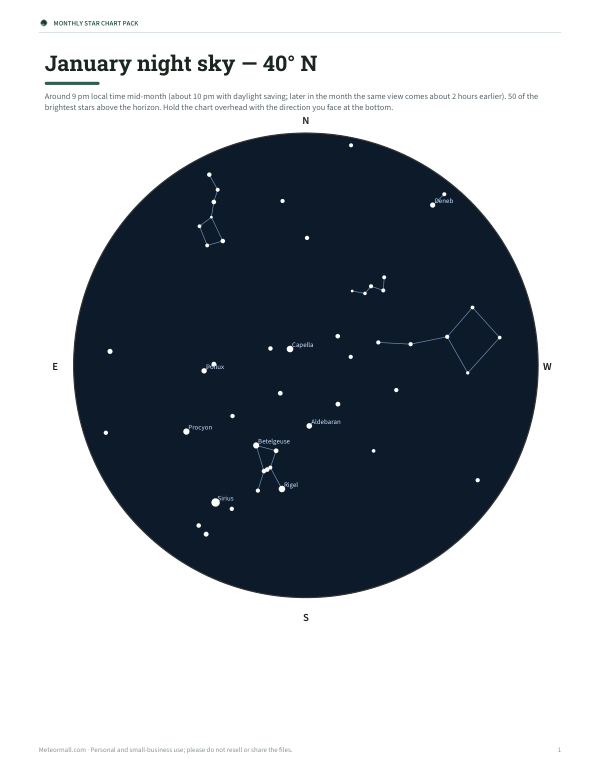 Printable Monthly Star Charts
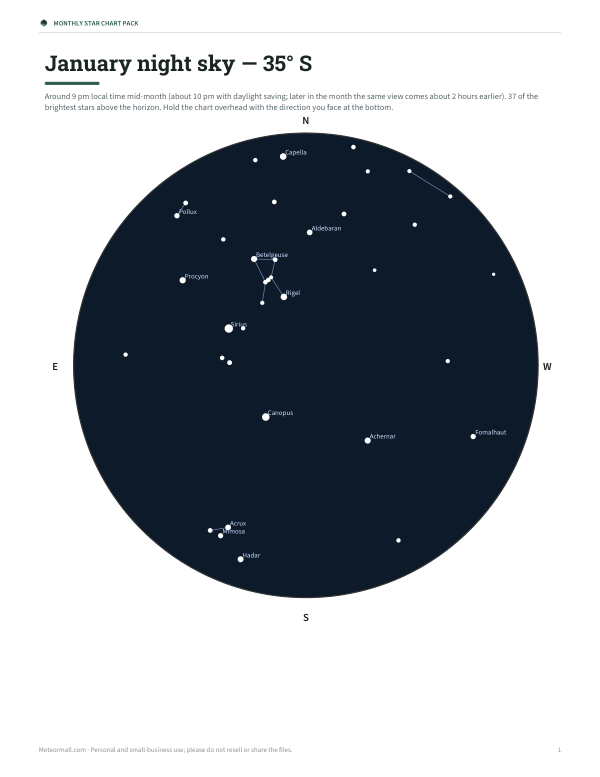 Printable 12-Month Star Chart 35° S
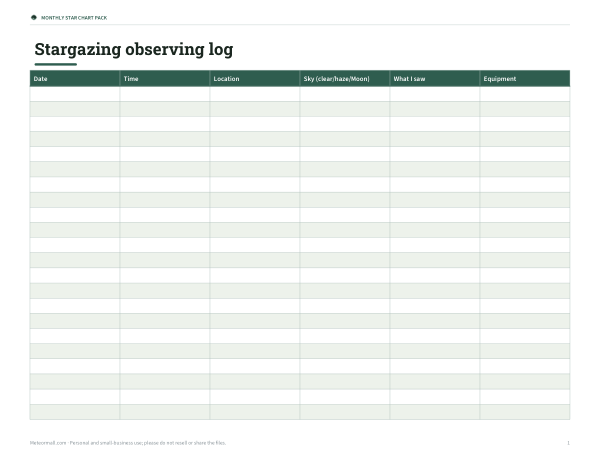 Printable Stargazing Observing Log
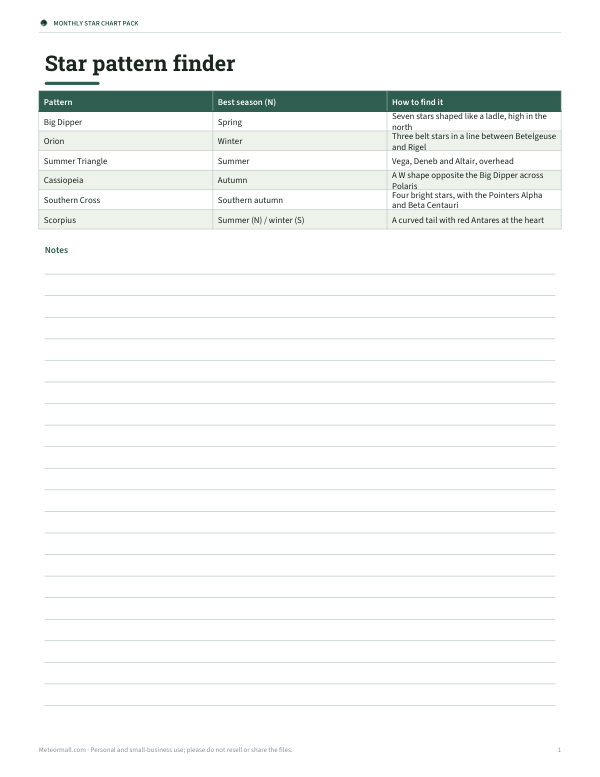 Printable Star Pattern Finder
How to use a monthly star chart
- Choose the chart for the current month and your hemisphere.
- Go outside around 9 pm local time (10 pm if daylight saving is in effect) and let your eyes adapt to the dark for 15–20 minutes.
- Find north (or south) with a compass or phone, then face that direction.
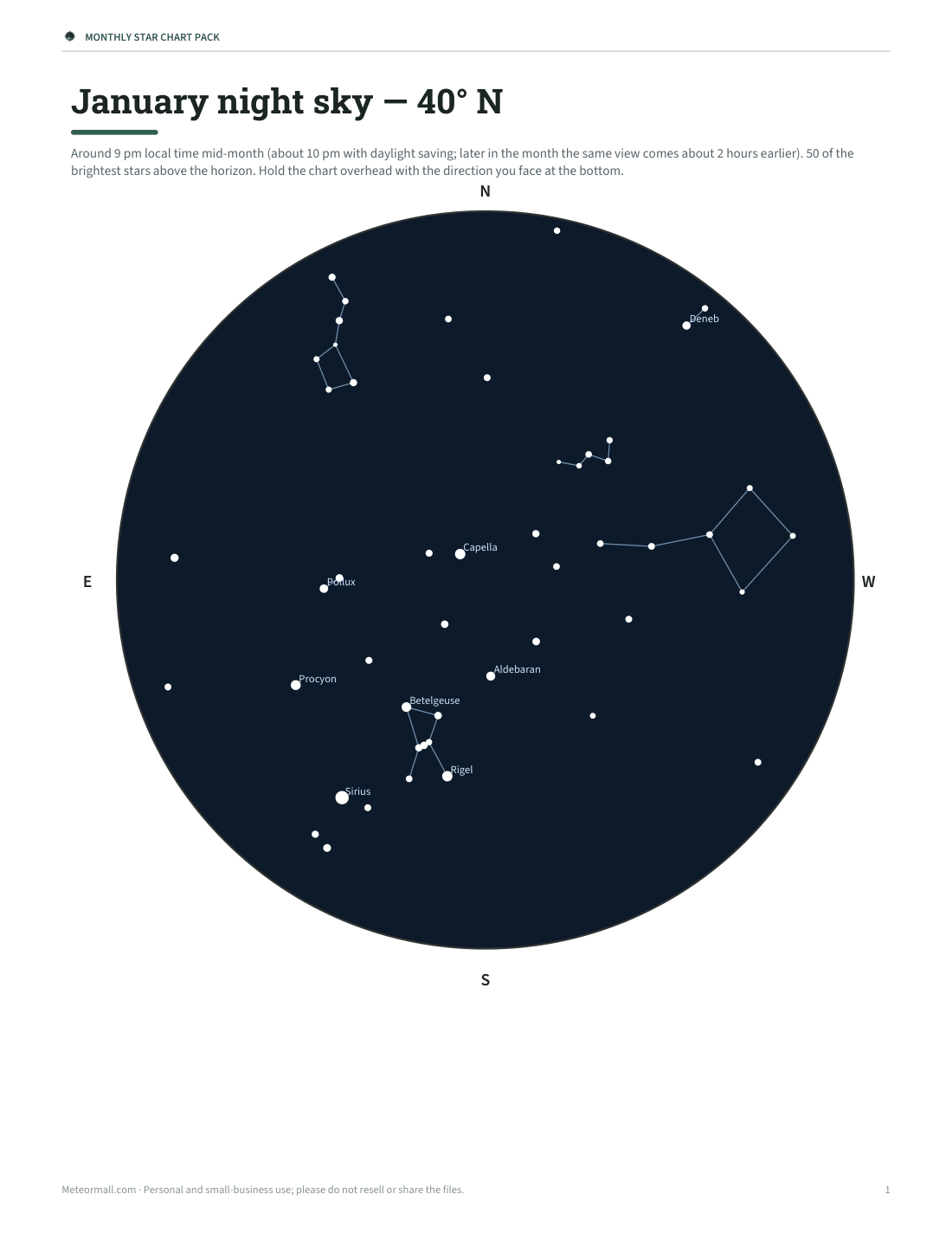
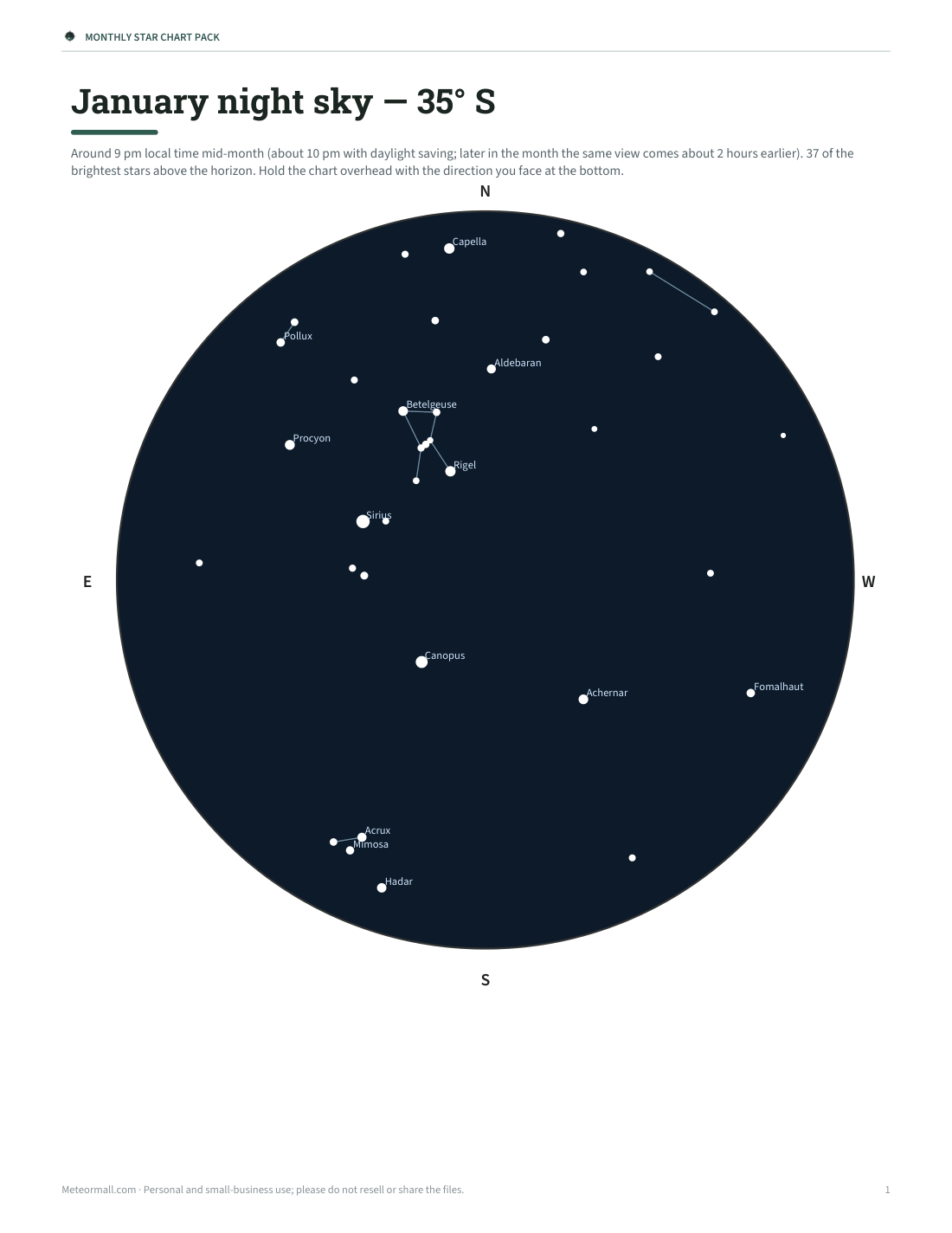
- Hold the chart overhead, or turn it so the direction you face is at the bottom — the chart’s edge is the horizon and its centre is the point straight overhead.
- Start with the brightest stars, then trace the patterns between them.
- Use a red torch to read the chart; white light ruins night vision.
East and west look reversed compared with a map. That’s correct: you’re looking up at the sky, not down at the ground.
Why the sky changes month by month
Earth’s orbit means the stars rise about four minutes earlier each night, adding up to about two hours a month. So the sky you see at 9 pm in the middle of a month is the sky you’ll see at 11 pm at the start of the month and 7 pm at the end. The same chart works for different times on different dates — and next month’s 9 pm chart shows what this month’s sky looks like at about 11 pm.
What’s on the charts
| Feature | Details |
|---|---|
| Stars | About 75 of the brightest stars; larger dots are brighter |
| Star patterns | Lines joining familiar groups such as the Big Dipper, Orion and the Southern Cross |
| Labels | Names of the brightest stars on each chart |
| Horizon and directions | The outer circle is the horizon; N, E, S and W are marked |
| Latitude | 40° N suits much of the US, southern Europe, Japan and northern China; 35° S suits southern Australia, New Zealand’s North Island, South Africa, Argentina and Chile |
Planets and the Moon move against the background stars, so they aren’t printed on fixed charts. A bright “star” not on the chart near the path of the Sun is usually a planet — often Venus, Jupiter or Saturn.
Seasonal highlights
| Season (northern) | Look for | Southern-hemisphere view |
|---|---|---|
| Winter evenings | Orion, Sirius, the Winter Triangle, Capella | Summer skies with Orion high and upside down, Canopus |
| Spring evenings | The Big Dipper high up, Arcturus, Spica, Regulus | Autumn skies with the Southern Cross and Pointers rising high |
| Summer evenings | The Summer Triangle (Vega, Deneb, Altair), Scorpius low in the south | Winter skies with Scorpius overhead and the Milky Way at its best |
| Autumn evenings | The Great Square, Cassiopeia, Andromeda region | Spring skies with Fomalhaut and Achernar |
Worked example
On a clear evening in mid-January at 40° N, the January chart shows Orion well up in the south-east at 9 pm, with Betelgeuse and Rigel labelled and Sirius below it to the left. Facing south and holding the chart with “S” at the bottom, an observer finds the three belt stars first, follows them down to Sirius, then up to Aldebaran and Capella. In the southern hemisphere the January chart at 35° S shows Orion high in the north, upside down compared with the northern view, with Canopus high in the south.
Getting a darker sky
- Move away from street lights and use buildings or trees to block glare.
- Check the Moon phase — a bright Moon washes out fainter stars; the week around new Moon is best.
- Rural and dark-sky areas show many more stars than city sites.
- Give your eyes time: full dark adaptation takes up to half an hour.
- Binoculars reveal star clusters, the Moon’s craters and Jupiter’s moons.
What’s in the pack
- 12 monthly charts for 40° N (one per page)
- 12 monthly charts for 35° S
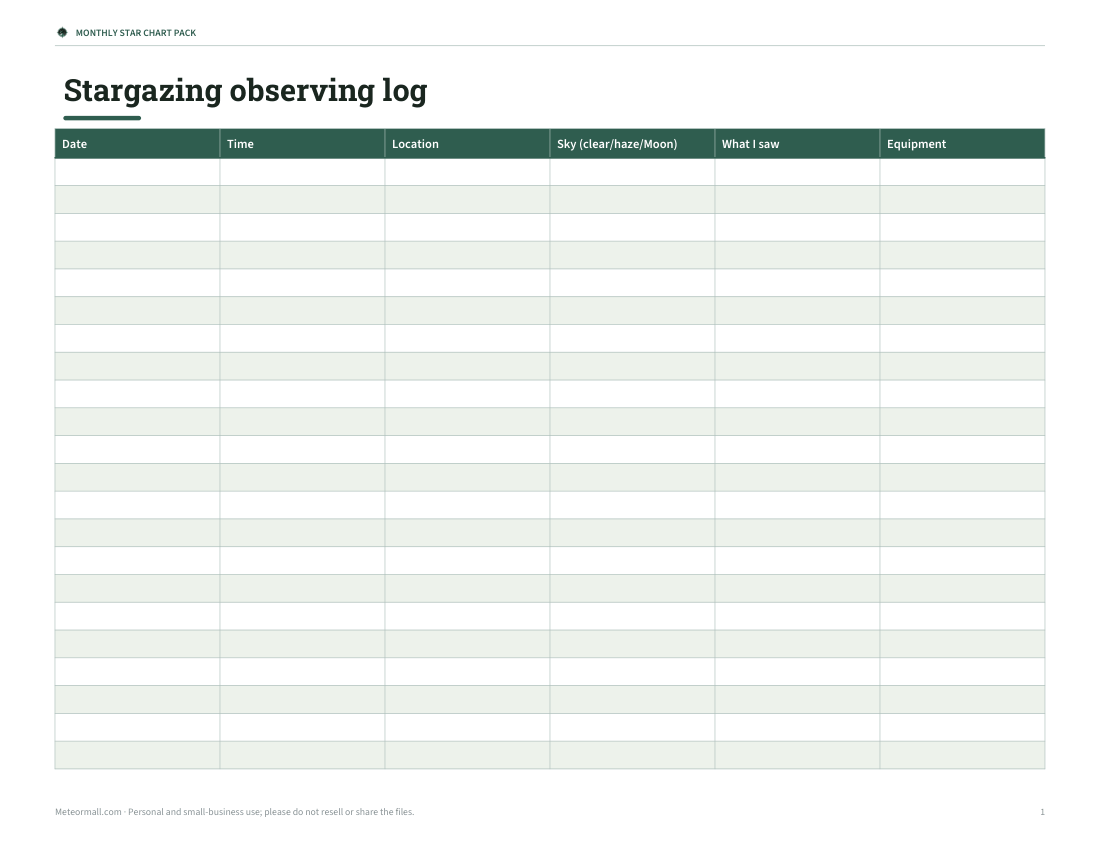
- Observing log for date, time, sky conditions and what you saw
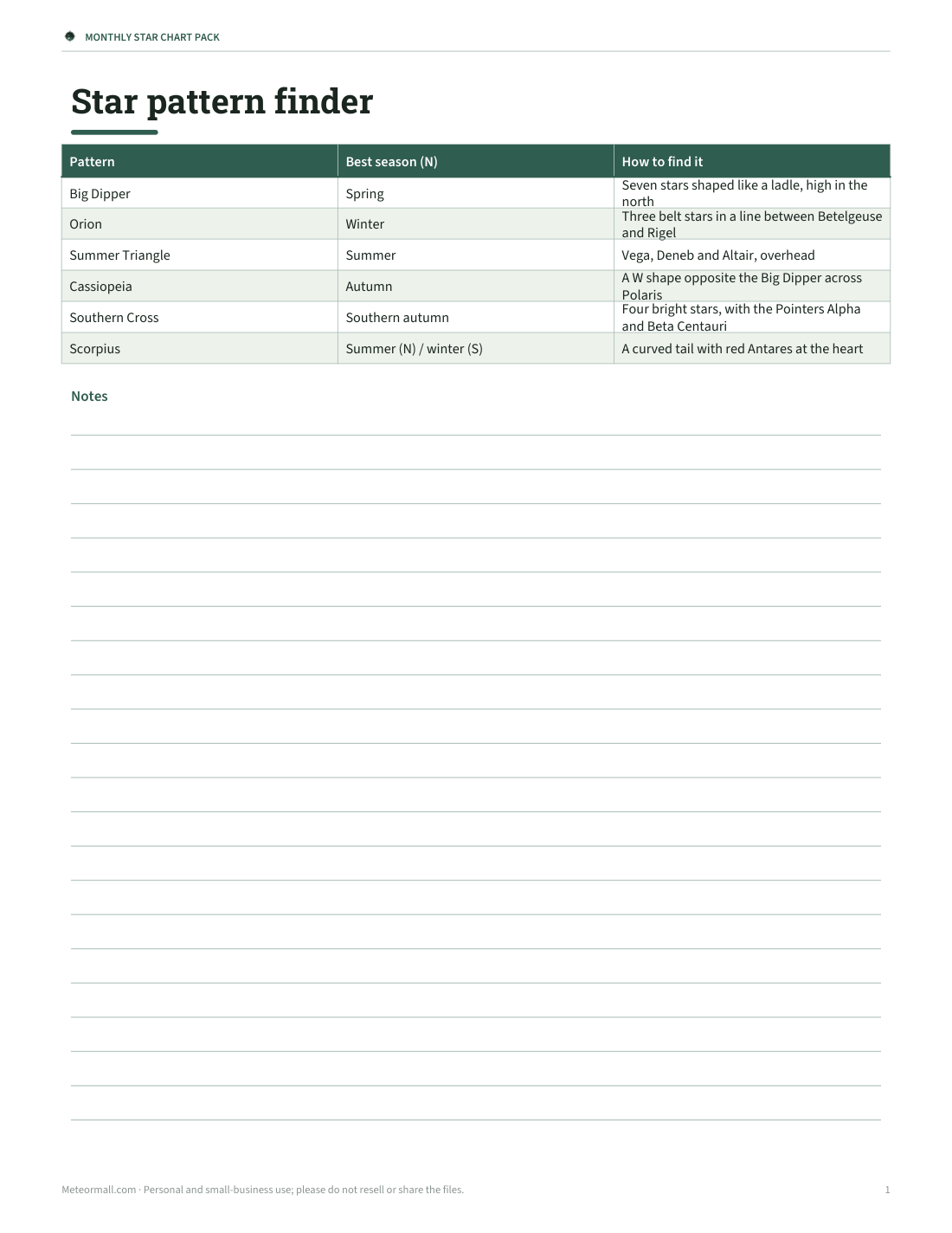
- Constellation finder cards for well-known patterns
- A red-light and night-vision tip card
All charts print on US Letter and A4. For best results print in colour; the dark background can be switched to ink-saving by printing in grayscale.
AI-assisted content
Charts were computed from standard star positions and checked before publishing; descriptions were drafted with AI assistance.
Frequently asked questions
How do I use a star chart?
Hold it overhead, turn it so the direction you face is at the bottom, and match the brightest stars first.
What time are the charts for?
About 9 pm local standard time in the middle of the month.
Why is east on the left?
Because you’re looking up at the sky rather than down at a map.
Are planets shown?
No — planets move, so they aren’t on fixed monthly charts.
Which chart should I use in Australia?
The 35° S charts suit southern Australia; they work reasonably well across mid-southern latitudes.
Is this a subscription?
No, it is a one-time download.